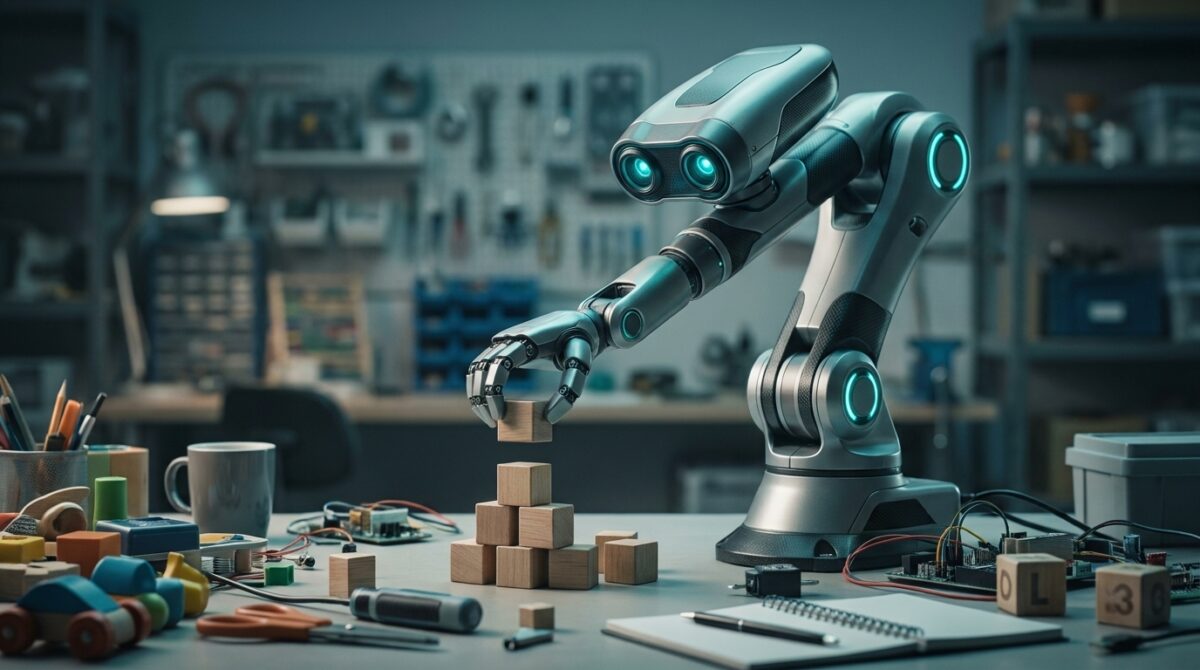
Google DeepMind released Gemini Robotics-ER 1.6, a model built specifically for robots that need to reason about the physical world.
ER stands for “embodied reasoning.” The model extends Gemini’s multimodal capabilities (vision, language, spatial understanding) into real-time physical interaction. Instead of a chatbot that describes what it sees, this is a system designed to understand spatial relationships, predict physical outcomes, and plan multi-step actions in environments it hasn’t seen before.
The timing matters. This dropped the same week OpenAI shipped computer use for Codex (desktop apps, background agents, 111 plugins) and Anthropic is scaling Claude Code Routines for unattended coding tasks. The frontier labs are racing through the same capability ladder: text, then code, then computer use, then physical-world agents. DeepMind just jumped ahead on the physical step.
Gemini Robotics-ER 1.6 is not a consumer product. It’s a foundation model aimed at robotics researchers and companies building physical AI systems. The pitch is that general-purpose reasoning (the kind that makes Gemini good at conversation and code) transfers meaningfully to physical tasks when paired with the right sensory inputs and action spaces.
This is the embodied cognition thesis that robotics researchers have argued about for decades, now backed by a frontier-scale model and Google’s compute budget. Previous approaches to robot learning relied on massive amounts of task-specific demonstration data. Gemini Robotics-ER attempts to shortcut that with a pre-trained reasoning backbone that generalizes across physical environments.
The 1.6 version number suggests this has been iterating quietly. DeepMind published research on RT-2 (Robotic Transformer 2) in 2023, demonstrating that vision-language models could directly output robot actions. Gemini Robotics-ER is the productized evolution of that research line, now integrated into the Gemini model family.
Why We’re Watching
The frontier AI labs are converging on the same roadmap: text, code, computer, body. OpenAI ships computer use. Anthropic ships unattended coding agents. Google ships a robot reasoning model. Each company is attacking the next layer of the physical-digital stack. The question isn’t whether AI agents will operate in the physical world. It’s which foundation model will be the default brain.
Robotics has historically been a hardware-constrained field. What changes with Gemini Robotics-ER is the argument that the bottleneck has shifted from hardware to reasoning capability. If a general-purpose model can understand physics well enough to plan novel actions, the hardware becomes interchangeable.
Watch for partnerships with industrial robotics companies (Fanuc, ABB, Boston Dynamics). That’s where this model finds its first real deployments, and where the gap between demo and production will be tested.