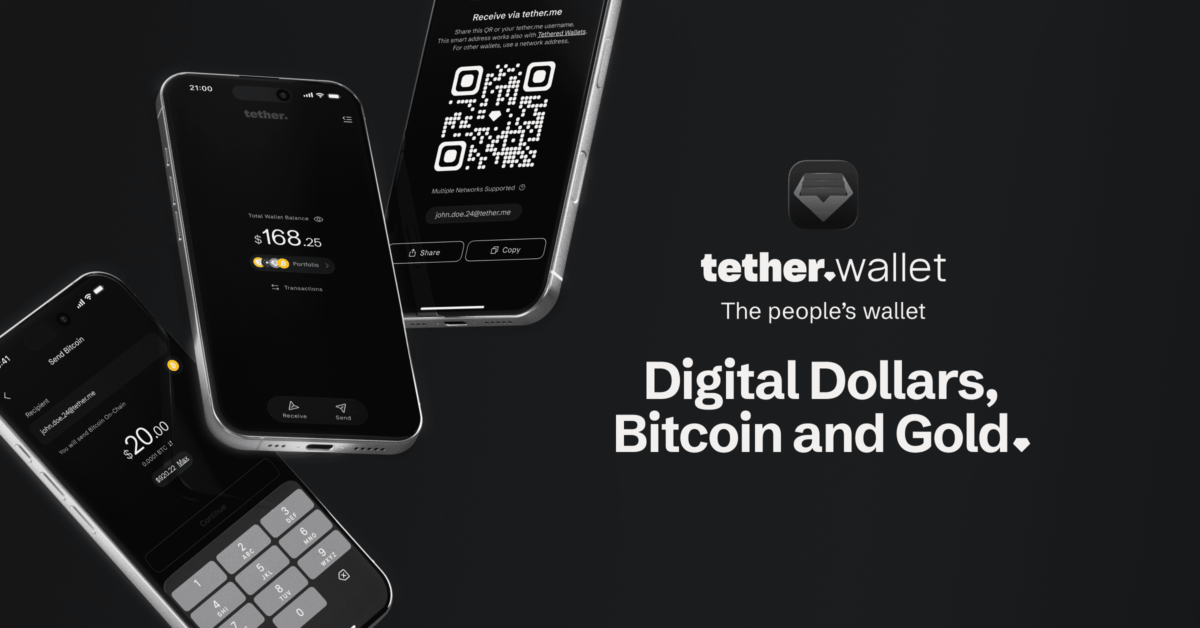
Tether just built a wallet.
Tether, the issuer of USDT, launched its own consumer self-custody wallet this week. It supports USDT, bitcoin, and Tether’s gold-backed XAUT token at launch, and it sits directly on the slot MetaMask and Phantom currently occupy: the default app a normal person uses to hold and send crypto.
This is the kind of move that doesn’t trend on crypto Twitter because it isn’t a price story. It might be the most consequential distribution move in crypto this year.
Tether’s reach, via exchanges, remittance corridors, and merchants across emerging markets, is genuinely massive. Until this week, the company had no owned distribution to convert that funnel. That changed.
“With more than 570 million people already using Tether’s technology, the next step is making that digital infrastructure even more accessible and usable by the end users,”
– Paolo Ardoino, CEO, Tether
Ardoino framed the product around removing complexity while keeping self-custody intact, positioning it as the people’s wallet for mainstream users rather than crypto natives.
The 570 million figure is Ardoino’s own count. Read it as a marketing number, it aggregates USDT holders, platform users, and partner-app reach rather than direct Tether Wallet users (currently zero, the product just launched). Even discounted substantially, it’s an enormous on-deck audience.
The product itself makes three choices worth naming. Email-style identifiers, so users see name@domain rather than 42-character hex. Non-custodial by default, Tether is not holding keys. And a deliberately narrow asset set, USDT, BTC, XAUT, with no ETH, no Solana, no meme coins. That last one is a positioning shot: this is a wallet for stored value, not a playground for speculation.
Nothing here is technically novel. ENS has offered email-style addresses since 2017. Non-custodial wallets are a commodity. What’s new is who’s shipping it and how they plan to distribute it.
Why We’re Watching
Tether owns the most powerful top-of-funnel in crypto and finally has a wallet to pipe it into. That matters nowhere more than in Africa, where USDT is already the default dollar. Chainalysis put Sub-Saharan Africa’s on-chain stablecoin activity at roughly 43% of the region’s total crypto volume in its 2024 Geography report, with Nigeria alone absorbing tens of billions in crypto transfers in the preceding year, the majority dollar-denominated. Triple-A pegs Nigerian crypto ownership at north of 10% of adults, among the highest in the world. These aren’t speculators. They’re people using stablecoins to get paid, to save, and to move money home. Every one of them currently holds USDT somewhere Tether does not control, Binance, Yellow Card, Bitnob, a MetaMask install. Tether Wallet is the first owned product that can convert that holder relationship into a retention relationship, and the first emerging market on the continent that tips hard toward it is the one where MetaMask’s narrative starts to crack.
The corresponding risk is concentration. A world where Tether is both the dominant stablecoin issuer and the wallet most users hold it in is a world where a single entity sits closer to the center of a lot of value transfer. That’s a structure MiCA, SEC, and Singapore’s MAS will have opinions about.
If Tether converts the funnel, it becomes a wallet company the way Apple became a payments company, by attaching a product to a distribution engine it already owned.
Watch the 90-day install numbers. Five million installs means MetaMask has a serious problem. Five hundred thousand means this is a footnote. Watch Nigeria, Kenya, and Argentina specifically, those three corridors will tell you whether emerging-market holders will follow the issuer into the issuer’s app.